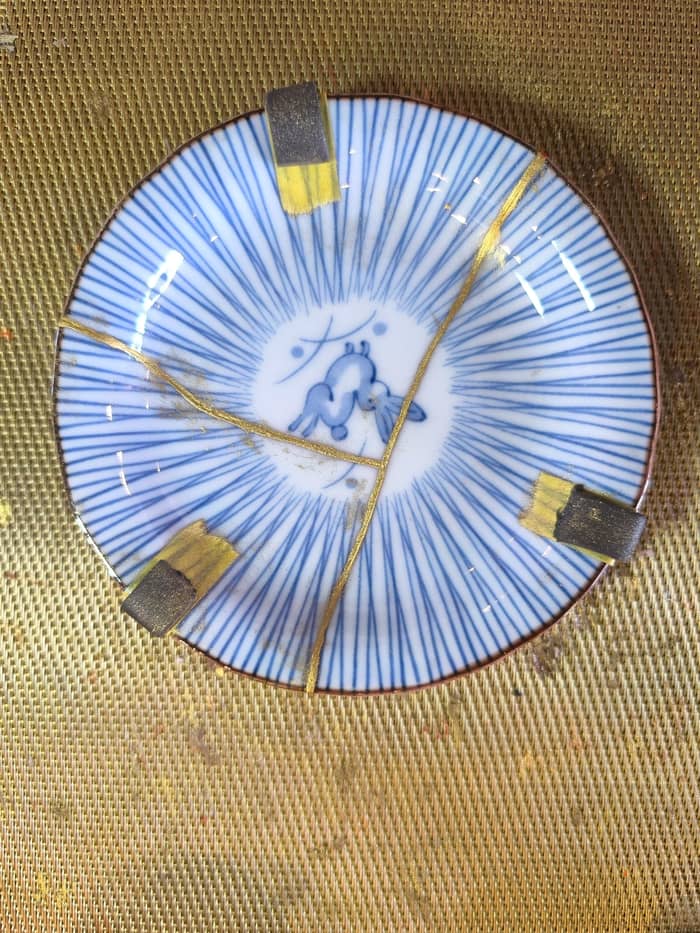
Traditional
Natural urushi and gold
The classical route
- BinderUrushi and rice
- MetalGold powder
- SpeedWeeks to months
Interactive tick list
Short answer
What to use for kintsugi: urushi lacquer to glue the pieces, a putty of urushi with sawdust or powdered stone to fill chips, and gold powder to finish.
Materials in brief
Checklist · 8 tasks
Tick off each point as you complete it. This device keeps your progress.
0 / 8 ready
Ready to go. Only the day is left: your 90 minutes at the bench.
Reserve a spotKintsugi is mostly a materials story: a tree sap that glues, a putty that fills, a metal powder that shows. Here is what each one is, what it costs the tree and the skin, and what a Kyoto workshop puts on the bench.
Editorial team, kintsugikyoto.com · Updated November 6, 2026 · Reading: 7 min
Facts at a glance
Ask what to use for kintsugi, the Japanese art of repairing broken ceramics with gold, and the honest answer is a short list with a long wait attached. Web Japan puts the method in one sentence: reattach the broken pieces with urushi lacquer, fill the cracked or chipped parts with a putty of urushi mixed with sawdust or powdered stone, and finish with gold powder.2 Everything else in the craft is a variation on those three jobs.
The classical technique, the one that was perfected in the Edo period, keeps even that list natural: urushi produced in Japan, rice powder and mountain soil.5 There is no solvent and no hardener in it. The lacquer does the gluing, the rice powder thickens it and the soil gives body to the filler. That is a very different shopping list from a modern hardware store, and it explains why a proper repair is slow, quiet work.
The proof is in old pieces. Web Japan points to repaired items more than 200 years old that are still intact as evidence of how durable those natural materials are.6 That durability is also why the craft cannot be hurried. Each material below earns its place by lasting, and each one asks something of the person who handles it, which is where the rest of this page picks up.
Material by material
| Material | Job | Made from | Note |
|---|---|---|---|
| Urushi adhesive | Joins the pieces | Raw lacquer, flour or rice paste | Hardens in a damp cabinet |
| Urushi putty | Fills chips and gaps | Urushi, sawdust or clay powder | Scraped and sanded |
| Gold powder | Shows the line | Pure gold | Usual choice, dearer |
| Brass or silver | Cheaper or paler line | Brass or silver powder | Gintsugi is the silver finish |
| Epoxy or cashew lacquer | Shortcut binder | Synthetic or cashew shell | Shortens drying |
Materials from Japan House London, Web Japan and JNTO; the summary of rows is ours.8,10,3,20,21
Urushi is a tree sap from the Japanese lacquer tree, and niponica describes it as a natural coating and adhesive used in Japan for more than 7,000 years.12 JNTO puts the history at 9,000 years, so even the official counts of its age differ by a wide margin.13 What they agree on is that nothing replaced it for the job of gluing and coating.
It is expensive because the tree gives so little. A lacquer tree is cultivated for 15 to 20 years, tapped over a five-month period and then cut down, and each one yields only around 200 grams.14 JNTO adds that a single 20-year-old tree yields no more than a cup of lacquer before it is felled.15 Most of Japan's supply, 70 percent, now comes from Joboji in Iwate.16
Raw urushi must be prepared before use. In its raw form it is poisonous to the touch and can take up to five years to process.17 After filtering, it forms a hard, waterproof surface when dried properly.18 The word to remember is dried: urushi does not simply dry, it hardens by absorbing moisture, which is why lacquerers keep it in a space with controlled humidity and temperature.19
The adhesive is made by mixing ki-urushi, filtered raw lacquer, with wheat flour or rice paste.8 LACMA's conservator describes the same idea: in the traditional process urushi is the binder, with rice glue, that holds the fragments together.25 The flour or rice gives the sticky lacquer enough body to bridge a hairline join. Kintsugi explained at the bench comes down to that: glue, fill, finish.
Where a chip or a whole fragment is missing, the gap is filled with an urushi putty made with fine sawdust or abrasive clay powder.10 A maki-e studio quoted by JNTO glues the damaged pieces with kokuso-nori, a kokuso urushi glue, lets them dry and polishes them flat before the next layer.26 The names change between workshops, but the logic is the same: build the missing volume, then smooth it.
Earth is a quiet ingredient in lacquerwork. In Wajima lacquerware a base coat of urushi is mixed with ji-no-ko, a ground earth made from diatomaceous earth that is baked and ground into powder.27 Web Japan's account of kintsugi names rice powder and mountain soil in the same way.5 If a studio mentions tonoko or ji-no-ko, that is the earth.
Which materials
Start with what the piece will do afterwards.
If A keepsake I will display
Urushi and gold
The classical method is natural and has lasted over 200 years in old pieces.6
If A first try to learn the steps
Urushi and brass
Brass powder costs far less and teaches the same hand skills.22
If A fast repair of a plate
Craft glue and paint
Web Japan describes it as the simpler method.23
If I react to poison ivy
Ask about the lacquer
Urushi comes from the poison ivy family.4
If A piece to eat from
Check the binder first
Listings differ from synthetic bond to genuine urushi.24
Three ways to build a repair
Traditional
The classical route
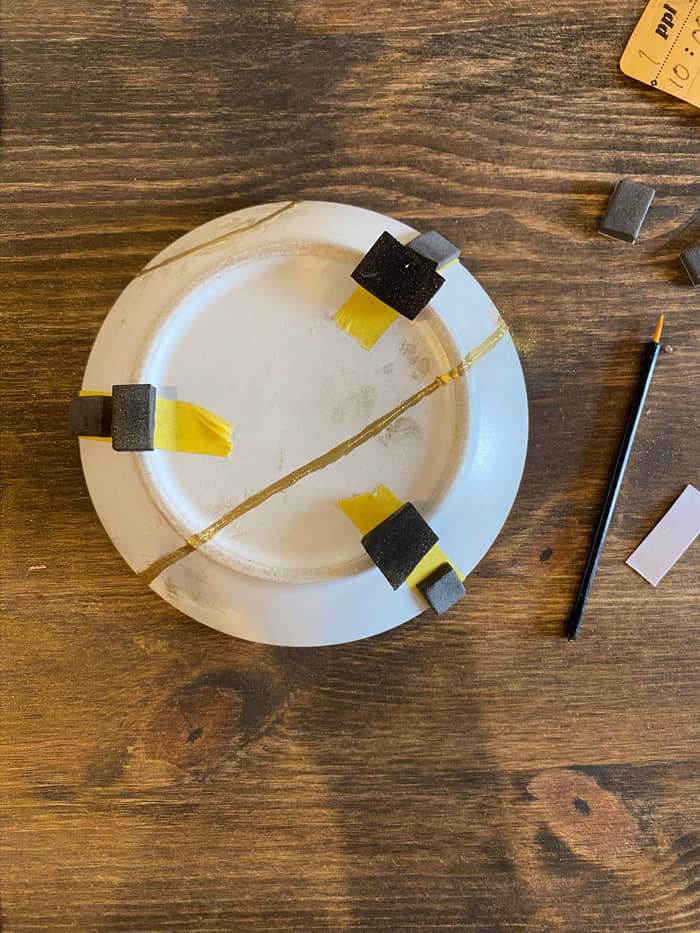
For learning
The practice route
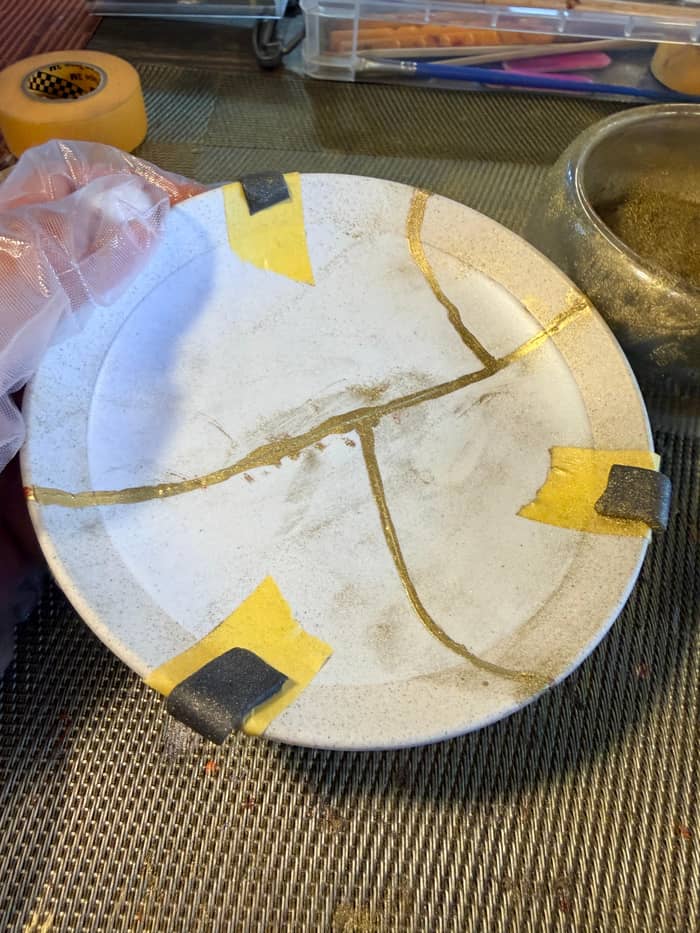
Quick
Simple kintsugi
The metal is the part everyone sees and the cheapest part to swap. Once each layer has hardened, the final lacquer layer is coated with pure gold powder, or in some cases brass or silver powder.3 Japan House London lists the silver finish as gintsugi and a repair with no metal powder at all as urushitsugi.20
Gold costs more than brass, and conservators know it. LACMA says gold powder is usually used in kintsugi but costs far more than the brass powder it used for a practice exercise.22 A Japan House London workshop for beginners also used urushi and powdered brass, a sensible choice when the point is the skill rather than the keepsake.28
Powder is not simply dusted and left. Gold powder sprinkled onto the cracks sticks to the excess glue seeping out of them.29 After the lacquer sets, burnishing the surface with a smooth tool lines up the metal particles and gives the gold or brass its gloss.30 Traditional finishing tools are agate or sea bream teeth, and one Fukui workshop polishes with a mixture of oil and powdered deer horn.11,31
Order of the materials
First
Broken edges are cleaned and filed before the adhesive goes on.7
Then
The adhesive mixes ki-urushi with wheat flour or rice paste.8
Wait
The joined piece rests in a drying cabinet for one to three weeks.9
Fill
Chips and gaps are filled with urushi putty, then scraped and sanded.10,11
Finish
Urushi goes along the seams, powder on top, then a seal and polish.11
Urushi is not a harmless craft supply. LACMA's conservator describes urushi as a toxic sap from the poison ivy family that can irritate the skin and throat of people who are sensitive to it.4 JNTO uses the same word, poisonous to the touch, for the raw form.17 Keep that in mind when a class advertises genuine urushi, and ask how the table is set up for it.
The medical literature is blunter about the active compound. A paper in the NIH archive calls urushiol a very potent allergen that commonly causes contact dermatitis after exposure.32 A Joboji lacquerer notes that Japanese lacquer contains more of the active component, urushiol, than lacquer from overseas.33 You do not need to be frightened of a class, only honest with the instructor.
The practical rule is simple. If poison ivy, mango skin or cashew shells have ever given you a rash, say so before you sit down and ask which lacquer is on the table. A reaction usually shows on the hands, wrists or face, so keep your hands away from your eyes and mouth until the instructor says you are clear to wash.
Video
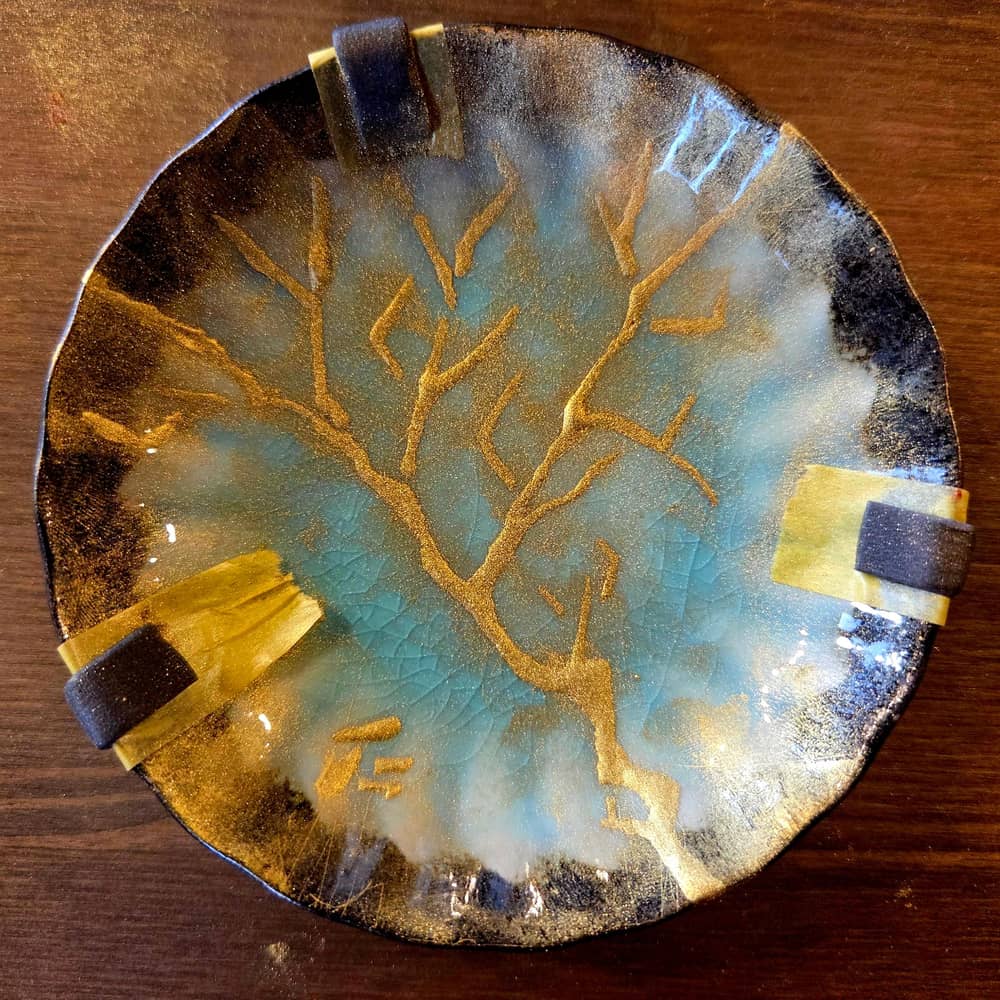
CBS Sunday Morning on YouTube · Video data is requested only when you tap play.
the basic process of reattaching the broken pieces with urushi lacquer, filling the cracked or chipped parts with a putty made of urushi lacquer mixed with sawdust or powdered stone, and finishing with gold powder remains the same
Because urushi cures slowly, shortcuts are everywhere. JNTO writes that some craftsmen shorten the drying time and the expense with synthetic epoxy and lacquer made of cashew shells.21 Web Japan describes a simpler method that uses a water-resistant craft glue that can be safely used on tableware, then traces the join with acrylic ceramic paint.23
A newer name for this is simple kintsugi, which the Japan Up Close site says came about because kintsugi is slow work and the lacquer needs certain conditions to harden.34 Japan House London built a workshop that included shortcuts so beginners could complete a finished product, as an accessible introduction.35
None of this is cheating, as long as the listing says what it is. JNTO advises checking the details of a course in advance, because workshops employ materials that range from synthetic bond to genuine urushi lacquer.24 A shortcut piece is a lovely souvenir; a piece you plan to eat from is a different question, which our food-safety page takes up.
The Viator record for our Gion workshop says the price includes tools and space to do kintsugi, and that a plates upgrade option is available. You repair a ceramic bowl or plate using traditional urushi lacquer and gold powder, according to the record, and the instructor has you clean the cracks, join the pieces, apply gold to the repaired lines and finish the piece to take home.
What the record does not say is which steps are done in advance. JNTO's listing of a one-hour Tokyo studio explains the trade-off: the curing of urushi is very slow, so a one-hour experience of traditional kintsugi is highly uncommon.36 In that studio the tableware has been partially restored in advance and each participant applies the finishing layer.37 A 90-minute class has the same arithmetic to solve.
So ask three things at the bench: which powder is on the table, whether the lacquer is natural urushi or a quicker substitute, and which steps were done before you arrived. The class begins at $18 per person, which is a fair price to learn what is in your own piece before you decide to buy a kit.
FAQ
Urushi joins the pieces, a urushi putty fills chips, and powder shows the line.2
Gold powder is usual; brass or silver are used in some cases.3
LACMA used brass powder for practice because gold is much more expensive.22
Urushi is toxic and can irritate the skin and throat of people who are sensitive to it.4
The putty is urushi mixed with fine sawdust or abrasive clay powder.10
A plates upgrade option is listed as well, for a better plate to mend.
Sources
Also worth reading
Wondering what goes into a gold repair? A real person answers here.