Join and seam
A clean crack
The simplest case
- FillerNone needed
- StepsJoin, wait, seam
- ResultOne thin gold line
Interactive tick list
Short answer
The types of kintsugi are named by the finish and the filling: gold, gintsugi with silver, urushitsugi with no metal, yobitsugi with other ceramics and mokuhen with wood.
Waiting and shortcuts
Checklist · 7 tasks
Tick off each point as you complete it. This device keeps your progress.
0 / 7 ready
Ready to go. Only the day is left: your 90 minutes at the bench.
Reserve a spotNot every break is mended the same way. The finish can change, the filling can change, even the missing fragment can come from another pot. This is how the methods differ and how the steps and the waiting fit together.
Editorial team, kintsugikyoto.com · Updated November 6, 2026 · Reading: 7 min
Facts at a glance
Most of the named types of kintsugi are named by what goes on the repair, not by the break. Japan House London lists several urushi methods: silver powder used as a finish instead of gold is gintsugi, a repair completed only with urushi and no metal powder is urushitsugi, and missing fragments replaced with pieces of different ceramics or of wood are yobitsugi and mokuhen.1
Gold stays the default. JNTO says that, once each layer has hardened, the final lacquer layer is coated with pure gold powder, or in some cases brass or silver powder.4 So a plate with a pale metallic seam may be silver or brass, and only a conversation with whoever mended it will say which. Ask before you assume the gold is gold, and ask again if the price seems to promise it.
Some terms describe older fixes that are not kintsugi at all. Web Japan names kasugaidome, in which broken fragments are held together with thick metal staples, and yakitsugi, in which pieces are fused back together using lead glass.5,6 Seeing a staple on a bowl does not mean a bad kintsugi job; it means a different repair tradition.
Name by name
| Type | What changes | Metal | Look |
|---|---|---|---|
| Kintsugi | Classic urushi repair | Gold powder | Gold seam |
| Gintsugi | Silver finish | Silver powder | Pale seam |
| Urushitsugi | No metal powder | None | Lacquer color only |
| Yobitsugi | Fragments of other ceramics | Gold or silver | Patchwork |
| Mokuhen | Wooden fragments | Gold or silver | Wood and ceramic |
| Simple kintsugi | Craft glue and paint | Paint | Fast, decorative |
Names and finishes from Japan House London; the simple method comes from Web Japan.1,14
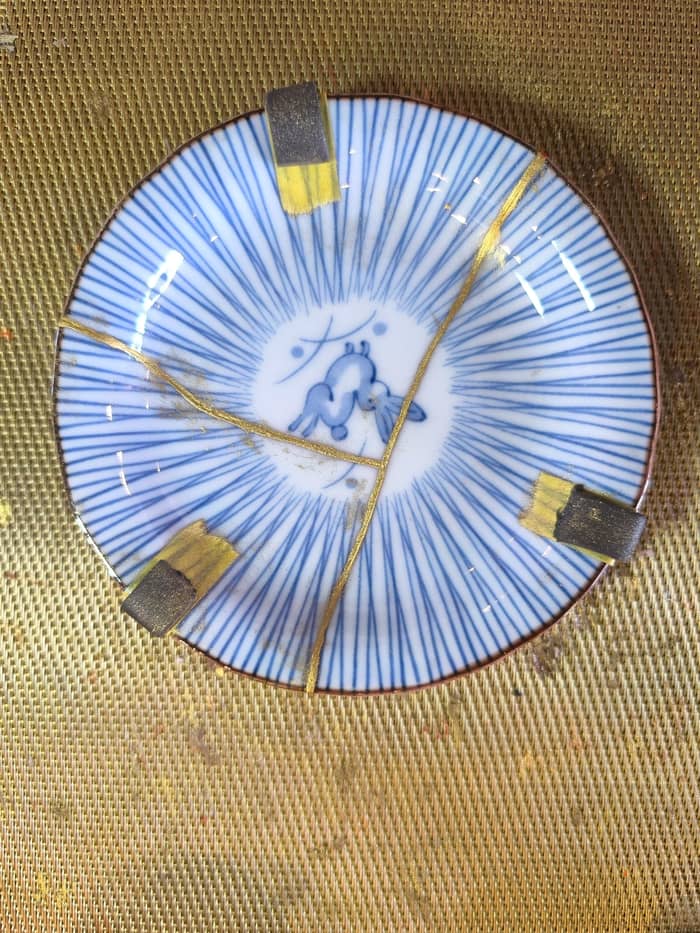
A single crack is the simplest case, and it shows the whole sequence. Broken edges are cleaned and filed before being pieced together with the adhesive, which is ki-urushi mixed with wheat flour or rice paste.7,8 The join has to be tight, because the lacquer is a glue and not a filler, and a gap left here will show later as a wide, uneven line under the gold.
Then comes the wait. The object goes into a wooden drying cabinet, the muro, for one to three weeks, at a warm temperature and humidity, so that the urushi hardens by absorbing oxygen and moisture from the air.2 LACMA's conservators use the same principle in a sealed box with a damp cotton towel in it.11
Last, the seam is dressed. Excess urushi is scraped off and sanded down, a coat of urushi goes along the seams, gold powder is sprinkled on top, and the dry finish is sealed with raw urushi and polished.10 The result is the thin golden river that most people picture when they hear the word kintsugi, and it is the part of the craft a beginner can reasonably expect to learn.
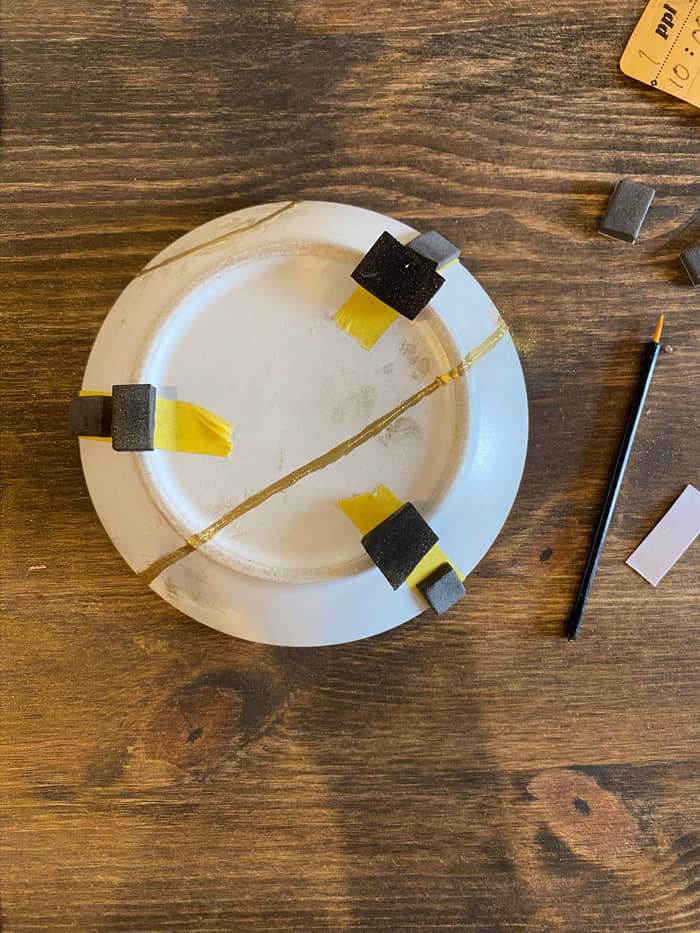
A chipped rim or foot has lost material, so the repair has to make some. The space left by chips or missing fragments is filled with an urushi putty made with fine sawdust or abrasive clay powder.9 Web Japan describes the same step in its summary of the craft, filling the cracked or chipped parts with a putty of urushi mixed with sawdust or powdered stone.16
The filling is where skill shows. LACMA's conservator says it is hard to teach because it takes practice to see and feel when a fill is correct, and that there is some trial and error in the learning process.17 A fill that is too high or too rough will be obvious once the gold sits on top of it, because gold is a mirror for every ridge beneath it.
Once the putty sets, it is scraped and sanded back, then dressed like a crack.10 The chip becomes a small gold-edged patch rather than a hidden repair, and that is the point of the craft: Japan House London says it highlights fractures to tell an object's story rather than masking them.1 Expect a chip to take longer than a clean break, because the filler needs its own curing.
Which repair
Start from the break, then pick the finish.
If One clean crack in a plate
A plain join
This is the case the standard steps are built for.7
If A chipped rim I want gold on
Putty and gold
Chips are filled with urushi putty before the finish.9
If I prefer a silver, cooler look
Gintsugi
Silver powder is used as a finish instead of gold.1
If A piece is missing for good
Yobitsugi or mokuhen
The gap is filled with other ceramic or with wood.1
If I only have one afternoon
Simple kintsugi
It exists because real lacquer is slow to harden.3
Three kinds of break
Join and seam
The simplest case
Putty and seam
Material has been lost
Patch or patchwork
A whole fragment is gone
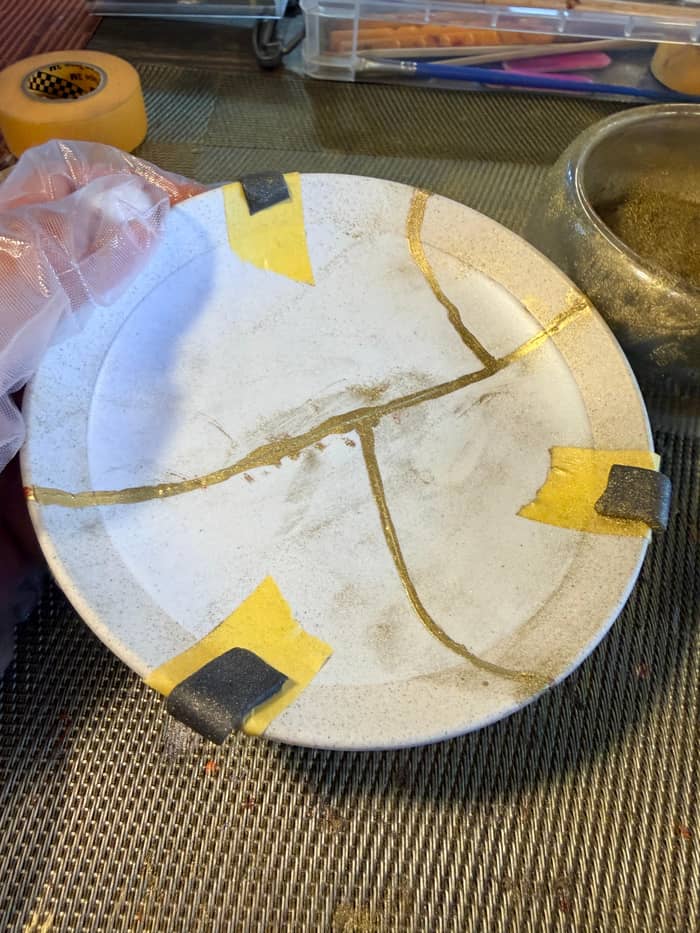
When a whole piece is gone, there are choices. The putty can be shaped to fill the loss, as with a chip. A maki-e studio quoted by JNTO glues damaged pieces with kokuso-nori, a kokuso urushi glue, lets them dry and polishes them flat, which suits gaps that need real body.18 It is the reason serious repairs are measured in weeks rather than hours.
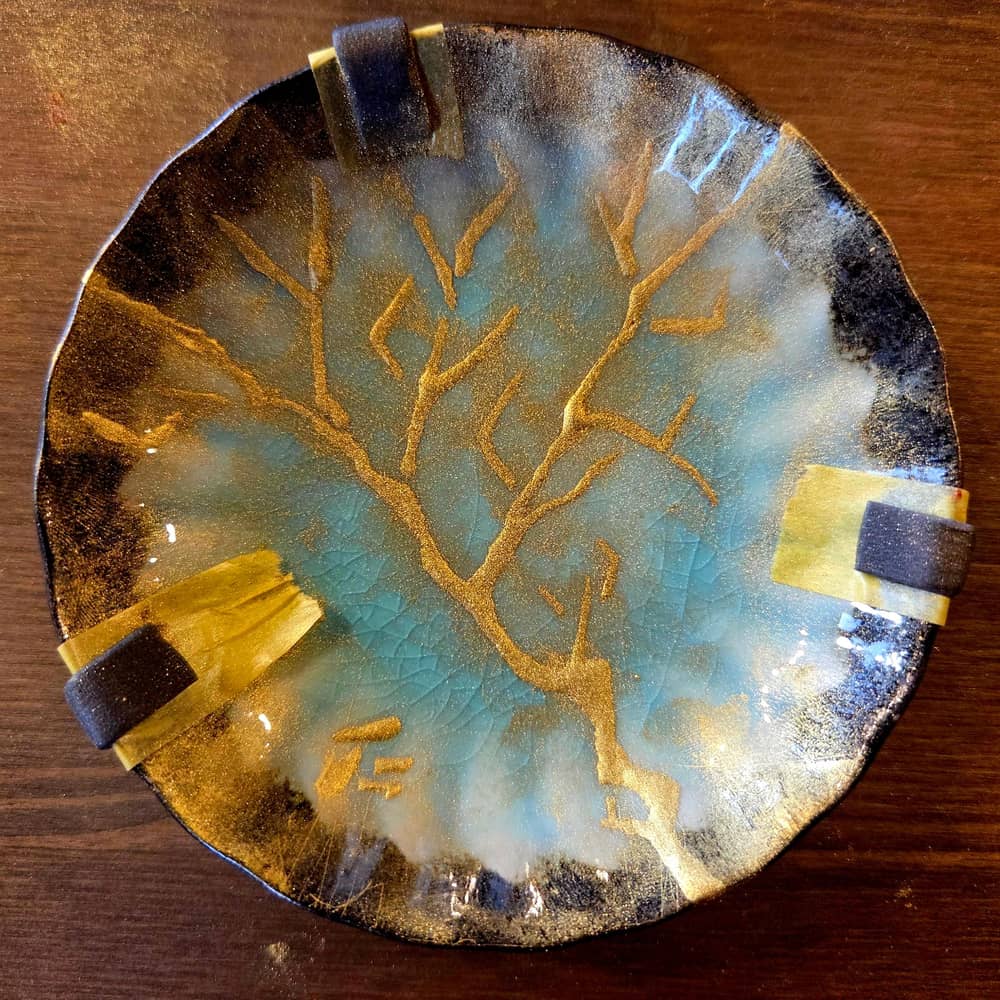
Or the gap can be filled with something else. Japan House London names yobitsugi, where missing fragments are replaced with pieces of different ceramics, and mokuhen, where they are replaced with wood.1 The result is a patchwork vessel, which is a very different object from the one that broke, and often a more interesting one.
That fits the philosophy. JNTO's luxury guide describes kintsugi as not an attempt to restore an object to its original state but a way of highlighting chips and fractures as a record of its history.19 If you bring a bowl with a missing piece, decide beforehand whether you want it to look whole again or to carry the loss on purpose.
A repair in order
Prepare
Broken edges are cleaned and filed first.7
Join
The adhesive is ki-urushi with wheat flour or rice paste.8
Wait
Warmth and humidity let the urushi harden.2
Fill
The putty uses fine sawdust or clay powder.9
Dress
Excess urushi is scraped off and sanded down.10
Finish
Gold powder goes on, then a seal and a polish.10
How does kintsugi work in practice? The steps are the same across the types, only the filling and the finish change. LACMA's conservator describes a fresh urushi layer being set a little in a humidification chamber, a sealed box with a damp cotton towel in it, before metal powder is tapped on while the urushi is not yet fully set.11
After the powder goes on, it takes another week in the chamber for the urushi to set completely.13 Burnishing then lines up the metal particles and gives the gold its gloss.20 A Fukui lacquer workshop describes the cabinet stay as about a week until the lacquer sets, with several weeks or longer for a whole repair depending on the complexity.12,21
Web Japan sets the ceiling at up to two months to complete a piece, because the urushi takes time to dry.22 That is the number to keep in mind when a class says you will finish a bowl in an afternoon. Either the steps were prepared, or the materials were quicker than classical urushi. Neither is wrong, but you deserve to know which one you are paying for.
Video
ABC Australia on YouTube · Video data is requested only when you tap play.
After the pottery pieces are glued, gold powder is sprinkled or dabbed onto the cracks in the pottery.
Speed has produced its own types. The Japan Up Close site describes a newer technique, simple kintsugi, which came about because kintsugi is slow work and the lacquer needs certain conditions to harden.3 Web Japan describes it as a water-resistant craft glue that can be safely used on tableware, with the join traced over in acrylic ceramic paint.14
Some craftsmen stay with real urushi but change the binder: JNTO says they shorten the drying time and the expense with synthetic epoxy and lacquer made of cashew shells.23 These are honest shortcuts when labeled as such, and they explain why two repairs that look alike can be very different in cost and in how they behave afterwards.
Teaching has its shortcuts too, and that is fine. A Japan House London workshop included some so that beginners could complete a finished product, as an accessible introduction to the principles and techniques.24 When you compare Kyoto classes, ask which family the class belongs to, because the price and the length usually follow from the answer.
How to kintsugi repair a piece you love depends on what the piece is. A modern plate with one clean break is a fair first project, and a cheap one to practice on. An heirloom with a missing fragment is a job for a professional and not for a first lesson, since a LACMA conservator puts mastery of kintsugi at a lifetime.25
Kits exist. Web Japan notes that the tools and materials are often sold together as kintsugi sets, and that in-depth videos make it easy to have a go.26 JNTO, though, says the best way to understand a complex craft is to try it hands-on with a seasoned practitioner.27 That is the case for a class before a kit.
Our Gion workshop is one such class. The Viator record says you repair a ceramic bowl or plate using traditional urushi lacquer and gold powder, cleaning the cracks, joining the pieces, applying gold and finishing the piece to take home. It is a way to meet the steps on this page in 90 minutes, from $18 per person.
FAQ
Gintsugi uses silver, urushitsugi no metal, yobitsugi other ceramics and mokuhen wood.1
The muro keeps a warm, humid space so urushi hardens by absorbing moisture.2
The urushi takes time to dry, according to Web Japan, so a classical repair cannot be hurried.22
It emerged because kintsugi is time consuming and lacquer needs set conditions.3
Kasugaidome holds fragments with thick metal staples, and kintsugi came after it.5
You repair a ceramic bowl or plate in Gion and take it home.
Sources
Also worth reading
Wondering what goes into a gold repair? A real person answers here.